
Part III: Iterations
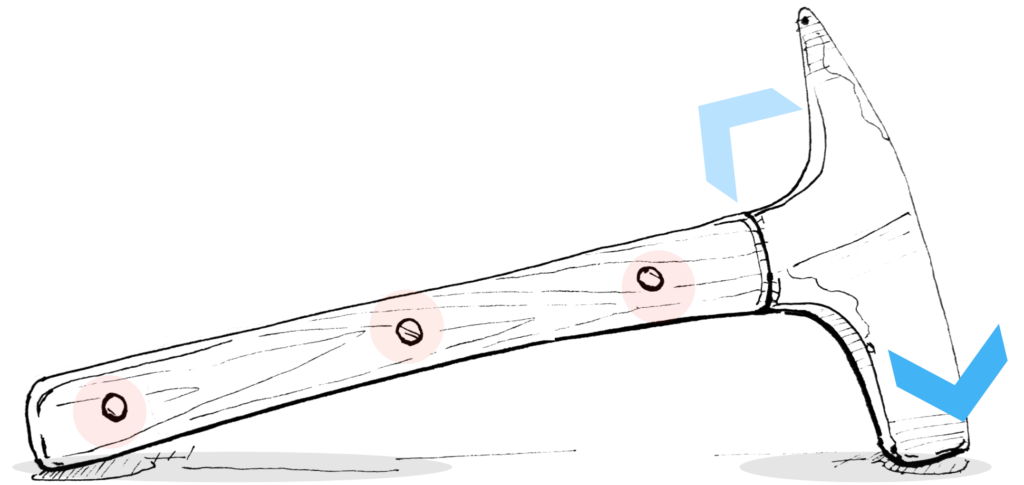
When explaining how his good friend Andy could tunnel his way out of prison with nothing more than a six inch rock hammer, ‘Red’ sums it up as a rather simple process – that of pressure, and time.
The Shawshank Redemption (1994) (clip)
“…the [IBM] Loop is observe, reflect, make, observe, reflect, make, reflect. And how many times you get through the loop, or trying to get through the loop as many times as possible for a given release of a given thing is kind of the goal. If you only have time to get through it three times, OK, then release it and keep going through it and release again. If you can get through it 100 times, even better.”
Phil Gilbert, on the Design Better podcast with Eli Woolery and Aarron Walter, 2025, @~39 min
“Don’t hang onto your ideas that hard…be willing to listen to the marketplace and keep adapting. Startups and products fail for only one reason:…They run out of money….if you didn’t run out of money and you were willing to try again, you would keep iterating on the idea until you got closer and closer and closer to what someone wanted to buy…I encourage you to listen, I encourage you to be ok with having five iterations of the product, not tiny changes, but maybe wholesale changes, wholesale ‘you were wrong’…It’s not about time, but now if you’re worried about running out of money, it is about time, meaning that you actually have to cycle quickly…you need to know you were wrong four weeks in, six weeks in, eight weeks in,… so you’re turning that wheel very very very quickly right, very quickly and get that feedback and turn it again and get that feedback until people go ‘you’re kidding?!’ [I believe the meaning here is, ‘you did it, you solved my pain point!’]… listen to your customers, they will tell you where the money is.”
Kevin Surace, on Kyle Evans’ podcast Prodity:ProductbyDesign, 2023, @~1 hr 04 min.
I was hesitant to transcribe such a long quote. Kevin basically riffed this whole thing in the last few minutes of the interview. But, I felt it captured beautifully the power of iteration to inevitably find a way, if we are able to let it.
Associating the rock hammer from Shawshank Redemption with iteration was something I came to late in this process.* However, that scene has always stuck with me over the years. When I’m not sure I can do one more round, or do it over again one more time, or what’s ahead of me is too overwhelming, this scene pops into my head. You can take a breath, a break, a rest, but you will find the way through, so long as you keep moving. That’s what strikes me about this scene; the simplicity of achievement. That at the heart of great success, is repetition of the simple motions, often with simple tools, applied with extraordinary discipline.
*if you haven’t seen Shawshank Redemption, first of all, how dare you ; )…But, spoiler alert, the main character tunnels his way through a prison wall over twenty years, using a little rock hammer. Also, it’s a great movie, but not one of my favorites. That’s a tie between Amadeus, and Bladerunner (with the Harrison Ford narration). While we are at it, Gizmo, Art School Confidential, and Struggle are my favorite design/art-related movies.
However, the discipline to apply simple principles, like test, redesign, repeat, at scale is incredibly difficult. To quote a couple of the most successful investors of all time:*
“The business schools reward difficult, complex behavior more than simple behavior, but simple behavior is more effective.” – Warren E. Buffett
“I can’t think of a single example in my whole life where keeping it simple has worked against us. We made mistakes, but they were not because we kept it simple.” – Charlie Munger
And lastly, perhaps the most poignant:
“Take a simple idea and take it seriously.” – Charlie Munger
*the article, “Charlie Munger and the power of Simple” by Mark Tobak at Hedge Fund Alpha includes a collection of these quotes.
Being open to the perspectives around you is a simple idea. Taking another pass based on that input is a simple idea. But could you do it over and over and over again? Could you repeat that motion faithfully for dozens of cycles, hundreds, thousands, over a career? Or, at some point would you convince yourself that there must be a “better” way, “I can outsmart the leg work, this is too simple, everyone is going to do it.” So, you stop making progress and you try to divine the answers because you think, you can be smarter than everyone else…which is just like everyone else. And the rare few that didn’t stop get ahead, the interest keeps compounding for them because they actually demonstrated one of the most difficult things you can will the instinctive human drive to do: keep it simple.
Platitudes aside, there is obviously nothing wrong with the impulse to “build a better mousetrap”. If people didn’t think they could do it better, faster, smarter, we wouldn’t have innovation. But again, how did they actually bring that innovation to fruition? 10,000 hours? 999 unworkable lightbulbs before finding the right one? The point is, repetition and iteration are still at the heart of the innovative impulse. They are also so easily thwarted in the real world. We get caught worrying we don’t have enough time to try another pass. We worry that it’s too late, or too early, or not the right time to iterate one more idea. We don’t have the money to do what we want to, it won’t be worthwhile if we can’t make what we need. Obviously, these can be difficult hurdles, but in these moments, is there nothing you can do?
Part III focuses on the act of creating, that half of the creative engine responsible for building the things we put forth for judgment by the perspectives that assign ultimate value. Let’s assume that at this moment you are NOT starting at the beginning of the prototypical user centered design process. Maybe you have a spectrum of products in various states of maturity, both in the market and in the pipeline. Maybe you are interested in optimizing a current product to better compete. Maybe you have a new project that was shelved after some initial exploration and being revisited. This section, as with the rest of the book, does not to require reading chapters in a particular order. Nonetheless, it would be a bit confusing to organize the contents randomly, so the topics in Part III follow a loose chronology from less to more granularity. After a high-level discussion of cycling (Perspective and Iterations) to keep things moving, the section starts with overall product vision, then moves towards discussions of feature creep, testing with users, and deciding when a product is done. It doesn’t really matter if you have already done some, most, or none of these things for any particular project. Wherever you happen to be, there is nothing wrong with taking a first, second, or third look at any part that makes up the whole. If that look reveals that a new iteration is needed, then perhaps we are all the better for having looked again.
Part III contents
Grey = currently planned chapters
Always keep it moving
When to start, how to start, what to start with
Where are your needs?
The costly commitments
The educated leap
The puzzle piece metaphor
When to test an iteration
What is valid?
Pushing the iterative process
Copy first, ask questions later…
The power of the reviewer
1 foot or 30,000 foot view
You have more time than you think
Freeze – when is design done?
Residual risk and outcomes
“Closing” thoughts