
Exploring the often unseen, unspoken, unwritten, yet undeniable nature of design hidden within the people and the process.
Introduction
Another perspective
“Artists often use reductionism to serve a different purpose. By reducing figuration, artists enable us to perceive an essential component of a work in isolation, be it form, line, color, or light. The isolated component stimulates aspects of our imagination in ways that a complex image might not. We perceive unexpected relationships in the work, as well as, perhaps, new connections between art and our perception of the world and new connections between the work of art and our life experiences as recalled in memory.”
Eric R. Kandel, “Reductionism in Art and Brain science. Bridging the Two Cultures”, 2016
When you break it down to essential components, design processes (whether you call it user-centered design, design thinking, human factors, etc.) all share similar principles and methodologies that can be applied when any product or service is being created. The principles of the design process are being taught everywhere from art schools to business schools and being employed by those developing everything from medical devices to financial services. Suffice to say, embarking as a team to create something new is nothing new.
*Although this is the official starting chapter, see the About page for more background on the approach to this book, about me, and links to some similar ideas.
Nonetheless, it occurred to me over time (and perhaps to you as well) that the models, diagrams, SOPs, methods, and techniques that are effective in teaching and guiding the key steps of consistent processes can’t possibly communicate all of the unseen, unspoken, unwritten, yet undeniable interplay between the people and the process. The “orderliness” that must be present on some level to succeed is perhaps obvious, but it is not the whole picture. Rather, I wanted to explore our interconnectedness to the design process as appendages of a whole, which can grow and develop over iterative, often idiosyncratic cycles marked by inconvenient discoveries, unsolicited inspiration, and contributions whose value is impossible to fully predict in the moment.
Still, this is not about reinventing, tearing down, replacing, or burning bridges created over decades of development processes, quality management, and creative thinking methods. In fact, it’s not really about methods or techniques or any particular process. It is about what we experience developing products together; the dynamics of people linked together through an idea, to produce the value and outcomes they want, expect, and need, often without neatly adhering to specific steps, planned priorities, or even logic.
I refer to this work as a “portrait” of the design process. There are a couple reasons for this. For one, the design process and these topics do not belong to me, or anyone for that matter, rather I am painting my impression of them. Secondly, as the quote at the beginning of this section implies, creating an abstraction of a topic helps bring clarity and reveal principles and relationships that are difficult to understand amidst the complexity of the lived experience. Presumably, how I see it can never be exactly as you see it. Such is art. Yet, in an age of infinite information, data, facts and outputs at our fingertips, perhaps the subjectivity of ”art” is one of the only tools we have left to help calibrate our perspective on our own terms. In other words, I hope you take my abstractions, philosophy, anecdotes, opinions, at face value and interpret, agree or disagree, in whatever way helps you reach your own conclusions about the constant stream of information inundating our attention.
All this talk of art might belie the fact that a large portion of my experience has been focused on human factors research and design in the medical industry. The focus on risk and severity of harm in this industry requires an intense thoroughness and commitment to what we think of as the user-centered design process.
It might seem ironic to write about how unpredictable the design process can be when I am extremely familiar with, and believe in the adherence to, the processes, techniques, and best practices that are thoroughly documented in various domestic and international standards and regulatory guidance. For example, it is a wonderful thing that medical device submissions are required to show evidence of human factors engineering (aka a user-centered approach).* We can take equal comfort in the relevant safety standards and long history of safety culture every time we travel in an airplane, for example.**
*for example, Appendix A HFE/UE Report in FDA’s Applying Human Factors and Usability Engineering to Medical Devices.
**With a recognition of the rare tragedies that can occur, still.
With this recognition in mind, there is still room to look at ”process” from a different angle, seeking to better understand what we experience, so we can recognize those patterns, and use them to our advantage – or at least be ready for them, so they do not misguide us.
Another iteration
In the movie “The Matrix”, Morpheus challenges Neo to accept that there is something inexplicably wrong with the world- something that is all around him but hiding just under the surface, something that he can feel, but can’t quite explain. This is when he realizes he is in The Matrix, a computer simulated reality where machines keep humans placated, physically hibernating in pods that capture their bio energy.
The Matrix (1999) Scene
That scene always reminded me of my relationship with “the design process” – an odd, simultaneous sense of comfort and discomfort. I have designed websites, posters, signage, embedded device UI’s, mobile apps, hardware, soft goods, packaging, and instructions and maybe some others I can’t categorize. I have conducted user research, usability testing, labored over detailed task and risk analysis and workflow diagrams, and written my fair share of reports. I have developed business plans, conducted cold calls, prepared sales events, and written more proposals than I can count. That is all to say, I have engaged in many facets of the product development process and collaborated with countless other specialists and users of the products being developed. And you? Maybe some, maybe all of those things and more? Yet still, I was left with a sense that what I experienced never quite matched what I was taught, what I read, or what was supposed to be the “right” process.
Like many of you I am sure, I did the job of product development whole heartedly. If a process didn’t seem to fit, if the situation called for a zig instead of a zag, I did it. My experience in this regard was not unique. I began to think critically about why it is that adaptation and non-linear thinking seems to be the norm, not the exception? What was design really all about then? How did it happen? Why did it seem to follow what was drawn in textbooks on a certain level, but seemingly not at all on a closer, more intimate level?
By the way, I am no nihilist or anarchist. Not in the realm of design or any other. I have heard there is a temptation to believe that there is no process, or to juxtapose against another scene from the Matrix, where a young boy bends a spoon with his mind, not because he’s telekinetic, but because he realizes “there is no spoon.”* The implication being that the design process is an illusion or doesn’t actually work or can be abandoned. I don’t believe this. I believe my design education, and design education in general, is incredibly valuable! The techniques and mechanical skills taught in design programs are the building blocks of proficiency, while the methodology being taught speaks to a general truth about problem solving, and perhaps the scientific method itself.
*I am certain I heard someone make a “there is no spoon” reference about design process, but I couldn’t find it in my notes. However, Rob Hamblin and Jeremy Miller discuss the same point on this Beyond UX Design episode, which is worth the listen.
I think of the Matrix scene at the start of this section as a metaphor about experiencing a thing everyday, but perhaps never fully seeing it for what it is. In other words, there really is something there. There really is something functioning and working. It just might not be what we think it is. We might have defined it in terms that work, yet that in itself doesn’t mean we are certain about how it works. My love of sci-fi aside, we can stop the metaphor there. I am not interested in extending the design process metaphor to include the elements of the world dominating, human enslaving machine-made virtual reality that made the Matrix plot wicked sick, kid (sorry, born and raised in Boston).
In the end, I simply* wanted to document the discussion I was having with myself about those aspects of design that were not so neatly written down and taught. Some of this discussion compliments or augments the standard practices very well. Other parts seem to cause friction with “the process”. Other aspects are simply anecdotes whose lessons seem to repeat and inform, like personal parables.
*note, there is nothing “simple” about writing, no matter how you do it, or how many people you coauthor with. That said, do you know the record for the most published works by one author?
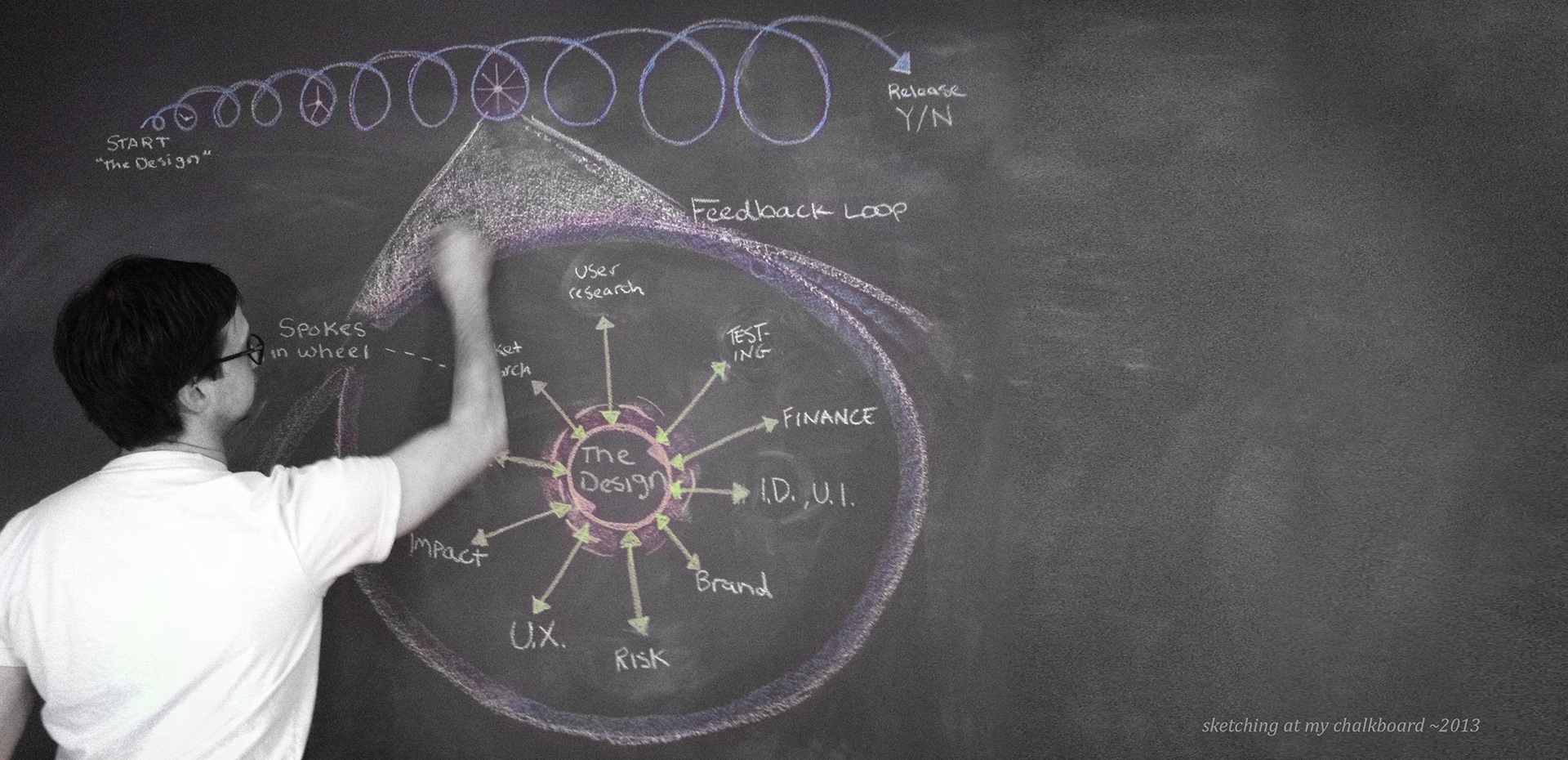
The chalkboard sketch at the top of the page is the portrait that inspired and helped me untie the ideas. But, its not everything, its just a start. I hope the outcome of this work is the same for you as I hope it to be for me: that it aids your thinking so you can be more effective in creative endeavors.
If reading in order, the next subchapter of Introduction is Portrait of a process.