

Part I: Our Process
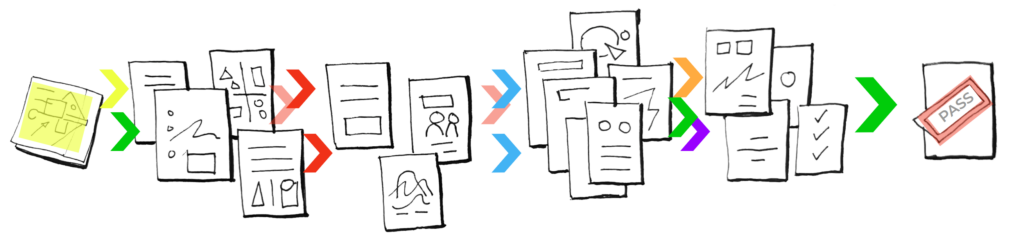
“You know what it is? People get confused. Companies get confused. When they start getting bigger they want to replicate their initial success and a lot of think ‘well, somehow there’s some magic in the process’ of how that success was created. So they start to try to institutionalize process across the company. And before very long, people get very confused that the process is the content. That’s ultimately the downfall of IBM. IBM has the best process people in the world. They just forgot about the content. And thats what happened a little bit at Apple too. We had a lot of people that were great at management process, they just didn’t have a clue as to the content. And in my career I’ve found that the best people are the ones that really understand the content. And they’re a pain in the butt to manage, but you put up with it because they’re so great at the content, and that’s what makes great products, it’s not process, it’s content.”*
Steve Jobs, as seen in 1995 PBS documentary, “Triumph of the Nerds” (aka “The Lost Interview”)
*In regards to the meaning of ”content”, I agree with Jeff Haden in this 2023 Inc. article, “Keep in mind “content” isn’t what we think of today as content; to Jobs, content was the outcome.”
“Day 2 is stasis. Followed by irrelevance. Followed by excruciating, painful decline. Followed by death. And that is why it is always Day 1.” – direct quote from Jeff Bezos. The following appears to be from other staff, but presumably is consistent with his opinions. “Good process serves you so you can serve customers. But if you’re not watchful, the process can become the thing. This can happen very easily in large organizations. The process becomes the proxy for the result you want. You stop looking at outcomes and just make sure you’re doing the process right. Gulp. It’s not that rare to hear a junior leader defend a bad outcome with something like, ‘Well, we followed the process.’ A more experienced leader will use it as an opportunity to investigate and improve the process. The process is not the thing. It’s always worth asking, do we own the process or does the process own us? In a Day 2 company, you might find it’s the second.”
There are two aspects of these quotes that I love. One is how inspiring it is to hear from two incredibly innovative figures that we ought to let our passion for achieving great outcomes drive our vision and our work. The other aspect I appreciate perhaps resides just under the surface, that this is coming from arguably two of the most brilliant “process engineers” in history. Amazon has dominated because of the process it employs bringing products to customers. They keep sharpening it and sharpening it and sharpening it. You could say that their process IS its product. In Steve Jobs, you have someone who believed in the power of vertical integration, which I would think requires quite a bit of process alignment. Consider what he said about the power of the “content”, juxtaposed with this quote “To me, ideas are worth nothing unless executed … Execution is worth millions.”* This is someone who deliberated over every detail** and revolutionized how Apple manufactured and delivered its product experiences.
*some additional ideas about strategy related to this quote in this Entrepreneur article by Aviva Leebow Wolmer.
**some interesting excerpts from Walter Isaacson (biographer) about Jobs’ attention to detail in this CNBC article by Ali Montag.
“Execution” and “Process” are not synonyms, but they are certainly related, and these successes don’t happen without good process and commitment to it. To be fair, there can be some nuance regarding what exactly Jobs or Bezos means or includes in the term “process”. However, without getting too lost in semantics I can directionally agree that, “what makes great products, it’s not process, it’s content.” and “…the process is not the thing.” But, I don’t think what they mean is that process is not a thing, or even that it is not a very important thing. Applying standards, requirements, and yes, tried and true processes are essential to drive quality, safety, efficacy, consistency etc. both when developing and when producing the products we all count on, or simply enjoy. We don’t enjoy tasty burgers at chains like McDonald’s because each one is made differently. We don’t have access to reliable cars that run for ~200,000 miles because people designing them are applying the myriad safety standards willy-nilly, or the people at the plants are milling out the engine block by eye, or assembling cars however they want that day.
Perhaps there is simply a natural tension between creativity and process, but this seems less like a bug and more like a feature. While recognizing the power of checklists and standardization, creativity and insight* can serve as a check against complacency. I tend to agree that when asked …”do we own the process or does the process own us?”, we ought to answer the former. This because we want the freedom to look critically at the process, and adjust its details, its implementation, if it is no longer serving as a bridge between the creative drive and the outcomes we seek. Put another way, if we devalue the creative spirit over process, or even just lose an appreciation for that tension, we might lose focus on what matters most – again, the outcomes. Otherwise that tension between creativity and channeling it will yield nothing, except maybe frustrated teams and poor products.
*maybe “creativity and insight” could also be called the innovative spirit, or the emergent wisdom of a team of individuals coming together, but it seems to me its at least that intangible energy available anytime people come together to solve problems.
In so much as this book needs focus too, I’m focusing on the creative development steps in the process. This is not at the exclusion of the other halves of the equation of manufacturing, distribution, corporate finance, etc etc. I will touch on them, for sure, but I’ll need to leave it to others to cover more directly. In this context of the “design” process, Part I looks at different examples of processes and projects and considers, how do they compare, why are they different, and is there a way to think across all of these different approaches so that we do not lose track of what matters to an overall mission?
Part I contents
Grey = currently planned chapters
Inspiration, Perspiration, or Execution
Back to the future
Four stories: the Smartphone, Febreze, Post-its, the Traveling Clog Family
What do these stories tell us?
Why vision matters (and doesn’t )
Capturing lightning in a bottle
The design process: evolution vs intelligent design?
[something]-Centered Design
Stage gate
Waterfall
Agile
FDA and user-centered design
V-model
Six Sigma
Influential Factors
“Be like water my friend”
In the end, we are all human