
Why vision matters (and doesn’t)
“does having a clear product vision matter?”
Google search, June 27, 2026
After scanning the AI summary and the first 40 search results covering how to create a strong vision statement and why it’s so important, I gave up looking for the contrary opinion. Although I have already referenced this Fast Company article elsewhere in the book, it included some poignant remarks about the inherent risks in following our visions: “But, important as it is, vision isn’t everything. Contextual and spatial awareness are equally important—they’re necessary to frame and focus that vision. And that’s one of the loudest messages I heard in the movie: The people of General Magic were so focused on The Vision Thing that they failed to recognize what was happening in the world around them.”- namely, the internet.
I’m still pondering whether there is anything profound in the lack of search results that present any risks in their titles, but in the meantime let’s talk about this ephemeral word, “vision”.
A close cousin to the ephemeral, inspirational moment of insight is the vision statement. A vision statement is a formal, thoughtful embodiment of a desired future experience, which can serve as a North Star. In general, it should be brief, anywhere from a tagline to a couple of pages, but there is a fair amount of flexibility in its style and scope. A phrase (aka a tagline) can be a vision statement. A set of statements outlining the envisioned experience and reactions future users will have can be a vision statement. A short story (another popular format) can be a vision statement.*
*A simple tag line is a nice spearhead, but it’s not enough on its own to facilitate commitment, let alone understanding. Nike’s “Just do it”, just doesn’t work by itself. You will want a well thought out rationale behind the tag line, which could be a couple pages simply to ensure the intended meaning is understood by stakeholders and teammates.
In a way, a vision statement can be the inception point of the development process. For example, an interesting interaction or application of a new technology can inspire you towards an overarching vision. It is the first point of formalizing inspiration and insight. In that sense, the “grandness” of scale is not a prerequisite for vision. A well-written recommendation to a specific design issue is like a mini vision statement. In other words, the same principle that applies to a minor design idea applies to what might be a massive undertaking in product development. Whatever form the vision statement takes, my only advice would be to not underestimate the amount of thinking that should go into working on it with your key stakeholders or the amount of work that might go into socializing that vision within a team.
*There are a lot of directions to go when discussing vision statements. For example, what is the difference between a vision statement and a mission statement? I scanned a few articles and I like how Julia Martins describes the process and differences between them (e.g., mission is what you are, vision is where you’re going). I also enjoyed this article from Richard Banfield on “Why Your Product Vision Might Be More Critical Than Your Company Mission” which shares some similar ideas to those here. More on how to craft vision statements can be found easily with a quick search. You’ll likely find a large degree of overlap on the suggested approach. This chapter is more about the purpose of vision and why we follow it yet change it too.
If a vision statement is a guiding star to our efforts, you could say it is tantamount to a commitment. However, it is reasonable to expect that the vision might shift over time as more evidence is revealed. For example, we might find that an existing or new feature becomes more important than initially assumed and changes the design approach. Perhaps in this case, the value proposition of the product does not fundamentally change, just how people interact with it. Taking a step further, what was initially a minor product feature might become so valuable that it spawns a direction almost unrecognizable from the original product vision. This might cause the team to develop an entirely new value proposition, revenue stream, or company itself.
Amazon.com started as an online bookstore, then became the juggernaut of online retail, selling every type of product in the world. This might have been Jeff Bezos’ intention all along, but the shift in how we value Amazon, and what we fundamentally think it is, has undergone one of the most dramatic shifts in the history of consumerism, let alone online retail. Netflix started as a mail order service, then as the technology evolved, the vision changed to optimize for digital on-demand experiences, but the essence of the company didn’t really change. Another example is Slack (enterprise messaging app), which was born from engineers creating a messaging app while developing an online game called Glitch. When Glitch failed as a product, the team (then called Tiny Speck) focused on the chat app realizing its potentially broad value to, well, teams just like them.*
*I had heard this story in conversation over the years, but this article on TechCrunch gave me more insight into how the team and investors thought about this pivot.
In the case of Slack, that team’s vision of what it wanted to do changed in reaction to a failure of one product and a re-imagining of something entirely different. However, for Amazon and Netflix, for example, a fundamental aspect of their vision also changed over time yet still retained other core aspects of the company as a recognizable brand. In one case, it was about what they provided under the same vision of how they provided (Amazon), in another it was about how they provided it under the same vision of what they provided (Netflix). When crafting a vision statement, how could one possibly know where the how and/or the what might separate from your best intentions. Too much specificity might be limiting, while not enough could leave a team directionless.
Perhaps we can side step this problem by recognizing that it is ok for vision statements to evolve and that we can create more than one, to serve multiple levels. A company as a whole might have a more solidified and simplified vision of its mission, which rarely changes, and vision statements that change year to year as a guiding principle for that time in the marketplace. Further down, an individual project can have a vision. As you might imagine, it would make sense for the vision statement at the most granular level to be aligned with the visions at each level up in the chain. In all cases they are subject to change, so the goal is not that there is always an everlasting vision. The goal is to ensure that there is always a CLEAR vision.
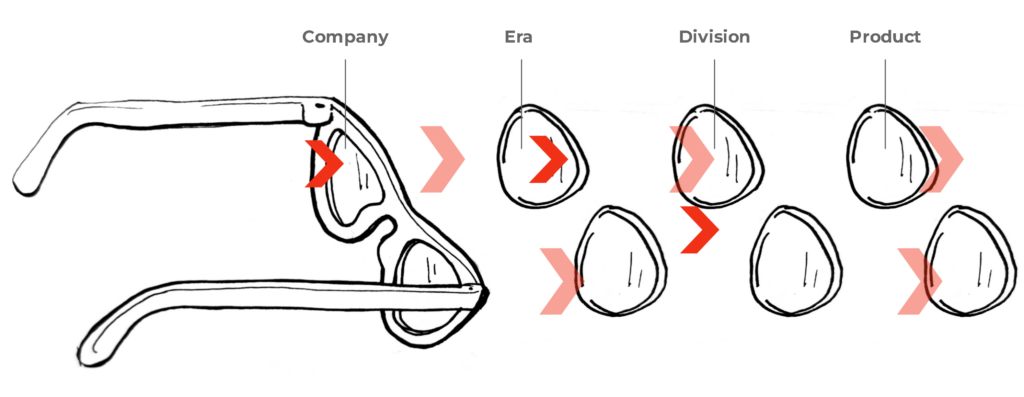
Vision statements can be deployed at multiple levels within the same company.
There is a saying in product development, “fail early and often”. This can be a controversial statement and one that I do not advocate as some kind of guiding principle of “good” process. For now though, let’s just use it as shorthand for leaning into fast iteration cycles. For example, a team might create an MVP, observe how it is used, how the customer reacts, and what they provide for feedback, then quickly revise and presumably improve. Some form of this fast release and iterate methodology is so ubiquitous it’s almost difficult to stop for a moment and consider the underlying “nature” of what is happening. We could expect the product to shift and morph more often then, in reaction, like a blob perhaps, that pushes out in various spots to test different directions before finding the best direction for growth.*
*If you would like to contemplate the nature of this idea for a bit, I suggest a fascinating documentary from PBS NOVA “The Secret Mind of Slime”.
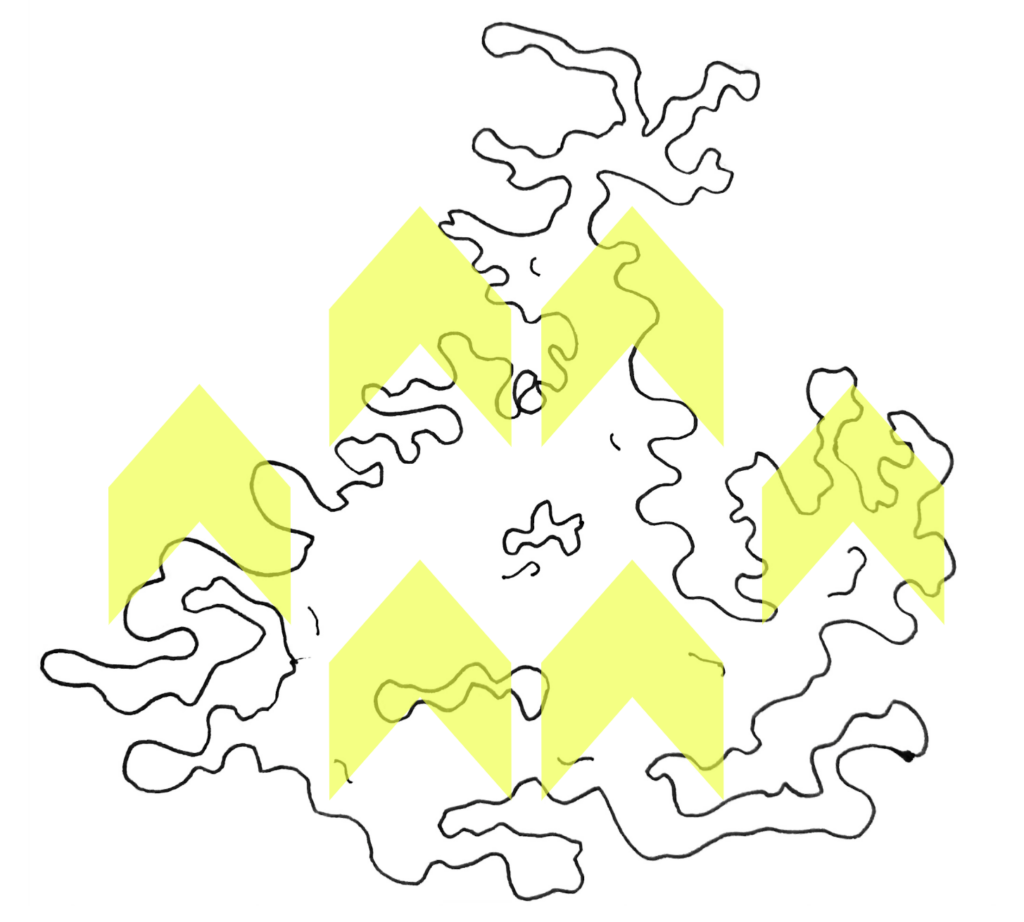
Slime mold will evolve in whatever direction it can grow.
As the iterative trial and error ensues, each version and its various functions will prove more or less valuable, attractive and useful. Moreover this process might uncover a more fundamental need that was once obscured before users could interact with a tangible tool. In other words, it might have been impossible to arrive at the vision that resonates most with users until you saw them interact with some initial solution.
This is where the nature of iteration and evolution become relevant. It’s not just applicable to the design, it’s applicable to the designer, to the marketing strategist, to the manufacturer, to the team, and it will change how they see and what they see. Like you would revisit your features, design decisions, service policies etc. upon each iteration, so too should you revisit your vision statement and honestly judge whether it still holds true. You can ask this question on the granular, project level, then also ask whether the revised vision remains consistent with the company’s higher level vision. If it doesn’t seem to, could this be the wrong product, or conversely is it a signal that the company’s vision is in danger of becoming antiquated because it doesn’t seem to have room for this new product vision? There are times when a team might envision a great product, but it wouldn’t be a good fit for the company. Attempting to push the company to get into the [insert product name here]-business could even be a disastrous mistake that would lead to the eventual failure of the product and/or threaten the health of the company all together. It’s possible the reverse could be true- recognizing that a latent feature or idea is the key to a company’s future evolution and health. Regardless of the conclusions a team might make, perhaps being mindful of the vision and vision statements can at least spark such conversations to occur, before it’s too late to do anything about it.
While being nimble is necessary, it’s important to realize that any product development effort, or established brand presence (good or bad), does not turn on a dime. All of the stakeholders, resources, and processes that must be brought to bear will require a clear understanding of how to change direction and in which direction to go. This makes communication and the skill of vision creation critical. Doing the research and analysis of the environment you are in as an industry, as a company, as a division, as a team, might guide you to change your cost targets, or how the product is deployed, it might be a seemingly radical change to the design, or only a change to its branding. We have seen companies evolve their vision over time in their outward-facing mission statements and branding. While they might stay true to certain principles present from the founding of a company, none-the-less the vision evolves. In the case of Coca-Cola’s main product, I would argue it’s not really about changing what it provides, but the “vision” of how it relates to the world does evolve.
A few slogans (brand platforms) for Coca‑Cola over the years (many, many more here):
- 1886 – Drink Coca‑Cola
- 1929 – The Pause that Refreshes
- 1969 – It’s the Real Thing
- 1982 – Coke Is It!
- 1990 – You Can’t Beat the Real Thing
- 2021 – Real Magic
Many of you who work in a corporate environment probably experience once a year, or once every few years, or once with every new leadership change, a new vision statement encapsulating the specific aspirations matched to that particular time and circumstance. Did “Real Magic” capture the zeitgeist of 2021 to now for Coca-Cola? I don’t know, so I read a bit more about it (see page here):
“The “Real Magic” brand philosophy is rooted in the insight that magic lives in unexpected moments of connection that elevate the everyday into the extraordinary—a timeless learning that feels more relevant than ever in today’s hyperconnected yet divided world. Real magic happens when people get together and when what we share in common is greater than what sets us apart.”
“We’re at an inflection point,” said Manolo Arroyo, Chief Marketing Officer, The Coca‑Cola Company. “The last 18 months have disrupted every aspect of life and presented us with a once-in-a-generation choice to go back to a binary, black-and-white way of seeing the world or help make the world a better place. ‘Real Magic’ is about creating a movement to choose a more human way of doing things by embracing our unique perspectives.”
The highlighted portions could have been bylines for this book! Whether that vision leads to new, amazing products or just a clarity of purpose for those working every day at the company, I couldn’t agree more with the spirit of that vision. Like a North Star, the vision impacts every decision, every step forward because it frames the meaning of the “right” and “wrong” way.
Because of this the vision statement plays a critical role in product development, and should be present when you embark on your journey. But, as the journey progresses, it’s healthy to check that vision to make sure it is still steering in the most productive direction. If the vision no longer seems quite right, or outright counterproductive, realize that can be normal and it’s ok to evolve it in order to course-correct. Perhaps that is the real magic for us humans and our teams of unique perspectives; the willingness to be guided, counterbalanced by the awareness to change the guide. It might be worth meditating on (I dunno, like a 17th century samurai might meditate on) the fact that with each new step forward we see a new horizon.
