
Exploring the often unseen, unspoken, unwritten, yet undeniable nature of design hidden within the people and the process.
About
One might think that good process guarantees good design. But, it doesn’t. While process and methods are critical, good design, not to mention good outcomes, also depend on the people involved. Our best chance of success just might come from understanding the often Unseen, Unspoken, Unwritten, yet Undeniable nature of design hidden within the people and the process. We might call this, for lack of a better term, the “unprocess”.
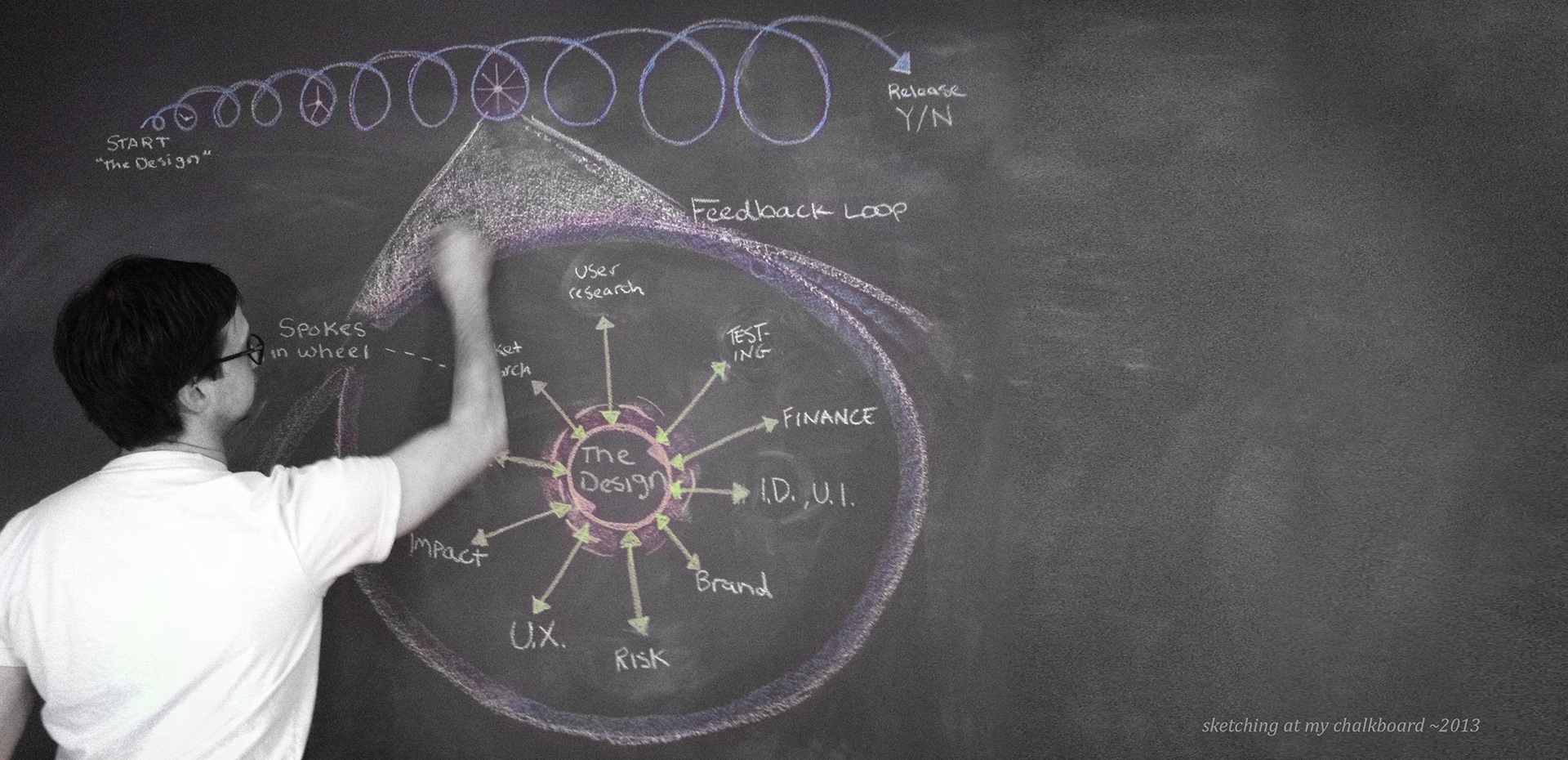
This basic idea has been gnawing at me for many years and is why I decided to write this book. I needed to try to better understand the nature of the design process and my part in it. Without seeking to tear down the tried and true, or pitch the new and improved, this book explores the design process, framed around an underlying principle: a yin-yang dynamic of Perspectives and Iterations that cranks the engine of progress. “Perspectives” reminds us to always seek input from the all the people connected to the design, and “Iterations” reminds us that no one version ever is, or needs to be, perfect. The more perspectives, the more we optimize an iteration, the more iterations, the greater the chances we uncover the optimal solution.* Ultimately, that is the common thread throughout this book: the more we help crank the cycle, the better the chances our efforts, products, services, or whatever it is we “design” can do its part in achieving the right outcomes.
*The image on the home page being this “portrait” of the process I was sketching in 2013 on my chalkboard.
The book’s format:
Although there is a structure and logic to the book, chapters do not need to be read in a specific order, and they will be released as they are finalized* – perhaps a meta-experience of the design process, or just giving me a little bit of freedom for the journey. Coupled with the audio, this project is somewhat of a mix of blog/podcast/book, but it is not open-ended. It will still be a “book” unto itself, with the contents more or less already set.
*The Full Contents page shows released chapters in red links, and planned yet unreleased chapters in grey.
The book’s structure:
The Introduction explains the overall key concepts I wanted to explore and why. The three main parts below also each include a brief preface with additional context for the topic.
Part I: Our design process
Looks at different examples of process and explores how they compare, how they differ, and how we might approach process without losing track of what matters to an overall mission.
Part II: Perspectives
Provides my take on many of the roles people play during the design process and how we might gain insights (and hopefully more success) considering the perspectives around us. These essays on the roles do not speak for those people – for that, you should go talk to them. It is simply meant to provide a stake in ground; how I understand their impact on my experience and the process.
Part III: Iterations
Focuses on the act of creating, that half of the creative engine responsible for building the things we put forth for judgment by the perspectives that assign ultimate value. This section follows a loose chronology starting with creating an overall product vision and moving towards discussions of feature creep, testing with users, and deciding when a product is done.
What this is and is not
This book reflects my opinions about design. This is a good place to state that this work is for informational purposes only, and not intended to provide professional guidance. Also, the views and opinions expressed in this work are those of the author and do not represent the official position of UL Solutions (my current employer) or past employers.
This book is method and product agnostic. It is not meant to promote one method or process over another, or get the last word on what is or is not the design process. It is not a how-to book, collection of quick tips, or a research paper with a set of claims. There is plenty of good content out there like that (e.g., books, webinars, tips, about design thinking and culture, team dynamics and communication skills).* Perhaps because of this I was compelled to take a different approach with this topic. In this case, I felt there’d be more value in sharing and exploring, than in prescribing – provoking thought for you and me both. Regardless, I do my best to present ideas clearly and directly, provide footnotes/side notes, references and links to more information where it seems helpful.
*some of which I have done myself, in webinars, blogs, and even a book I co-authored with some colleagues, Designing for Safe Use, which is entirely about safe design principles.
There are no shortage of ways to approach the design process and, again, no shortage of great information, guidance, and research out there that dives far deeper into any specific aspect covered here. I explore many aspects of the design process – some of those I have quite a bit of experience with, while others not so much – but, admittedly, that comes with the limits of my bias, my perspective, and simply what I’m most interested in. For example, the line between “building the right thing” and “building it right” is certainly blurry. Given that the topics within the latter are vast (e.g., engineering to spec’, manufacturing, distribution), and given my experience as a designer, this book is more oriented to the former. That said, developing the right manufacturing or sales strategy can certainly be considered a form of “design” in its own right. Anything subject to answering the unknown could relate to “building the right thing” too. Despite this blurry, perhaps arbitrary line, I do my best to navigate topics at least from a consistent position: focusing more on when we create the new or improved rather than when we recreate it many, many times after that.
Taking a step back, this book is more about how we are connected by what we work on, regardless of what the “what” actually is, or the process by which we create it. Like the sketch on the chalkboard pictured above, this is a “portrait” of the design process, painted with my 25+ years of experience, deep as it is, yet never complete. It is informed by many others I have worked with and read and listened to over the years. However, it is mainly inspired by a few simple, recurring observations. For one, I noticed that when I focused on the people involved, not just the problems to solve, I was able to garner more valuable, not to mention unexpected, inputs and insights, and facilitate more cohesive solutions. Then, the more I understood others’ perspectives and roles in the process, the more I understood my own. With better clarity, I could provide better input, and make better decisions, more quickly, to help the team iterate. To link back to that Perspectives and Iterations concept stated earlier: the more we help crank the cycle of progress, the better the chances our efforts, products, services, or whatever it is we “design” can do its part in achieving the right outcomes.
No matter what role you play in product development, this shorthand of “the cycle of progress”, or “Perspectives and Iterations”, might remind you to get just a bit more feedback when, and from the people, least expected. Or, it might remind you to try for one more design round when it seems like it can’t be done. If anything in here can help you do that, whether you read some, all, or no further than this paragraph, it will have served its purpose.
I hope you find this work enjoyable and thought provoking. Even if you disagree with everything in it, perhaps that still provides useful guideposts as you map your own landscape of opinions.
> About me, Similar ideas, Style, Thank you (and sorry) <
About me
I’ll leave the details of my credentials and career neatly listed on LinkedIn, but to summarize I have primarily been a design consultant for over 25 years. My undergraduate is in Industrial Design, my Master’s degree is in Human Factors in Information Design, and I am a Certified Human Factors Professional. My roles have mostly been working on or managing small teams, as opposed to large teams or organizations. That said, I have worked on a wide variety of projects with a wide variety of teams and companies of all sizes. For the last 15 years this has been primarily in the medical space.
I consider myself a designer first and foremost. The book, for better or worse, is fundamentally grounded in that perspective. However, I regularly work on or manage multi-disciplinary projects, human factors analysis, user research, and usability testing, and have done my fair share of cold calls, sales presentations, marketing and business initiatives, webinars, and teaching.
Similar ideas
Since I first sketched this “portrait” of the design process on my chalkboard in 2013, I wasn’t certain it would be useful to anyone but me. As I started writing this book, I looked for ideas, articles, podcasts etc. that seemed similar to what I wanted to explore. This does not mean a) I fully agree with what I found, b) that these folks would agree with my opinions, or c) that I found everything that would be relevant. However, it was nice to realize that I was far from alone in many aspects of my thinking. The following are a few that really stood out:
- Boundary spanning. This 2010 article relates to the core concept with a very similar circular diagram except that the main premise is about the “boundary spanner’s” central role.
- FDA’s Total Product Life Cycle (very similar diagram). This 2009 article summarizes the concept, and reiterates the importance of connecting disciplines, potentially with a central “Product Development System”.
- Honest UX podcast #72 Design Processes: expectations vs. reality. Many, many people have touched on these ideas in podcasts, articles, and blogs, but I call out this one because it is such an on-target, 30 minutes.
- Scott Berkun on “Why Design is Hard”. I didn’t get to the book (yet!), but in this presentation (also interviews 1, 2), he is clearly getting at some of the same core principles, like embracing the design process as an interplay of diverse individuals and roles (and how designers can deal with it).
- Daniel Newman’s well known Design Squiggle, is a great expression of the experience of the design process. It’s also unintentionally similar just in terms of the phrasing (i.e., The Design UnProcess, The Design Squiggle)
- Natasha Jen: Design thinking is bullsh*t. Putting evidence, outcomes, and collective critique over an increasingly checkbox approach to design.
- Metalab’s “Down with the Double-Diamond” method has similar inspirations and visuals, and the best name for a design technique I have encountered yet: “Tarantinos”.
- Marty Cagan’s “Leading Complexity with Context not Control” is an amazing webinar about how innovative teams ought to be process-agnostic and focus on first principles.
Perhaps there is nothing you can say that hasn’t already been said. But, ideas are not always so easy to parse, explore, understand, or express. So, even if all you can do is re-hash, re-state, re-configure, and re-orient ideas about our common experiences, that just might make it easier, that just might make it more resonant for the next round.
Style
In terms of writing style, I do my best to avoid ubiquitous prefaces such as “I think”, “I believe”, “from what I have experienced” or “It seems to me”, simply for the sake of conciseness. Such caveats still show up sparingly, for example to introduce a new concept or high-level position I am taking. Or, where I am unsure and feel it’s best to share my own uncertainty and open questions, I try to make that obvious (e.g., it could be, it’s unclear to me whether…). I also often use the royal “we” rather than repeatedly saying “I”. In the same way that I encourage teammates, students, or anyone else (including myself), I’ll offer opinions and assumptions on what I think “we” are doing and experiencing, knowing not all things apply to all people. Overall, I try to write with a sense of fun and in simple objective terms (e.g., the design process often does not follow a linear process) unless it seems inappropriate.
Why the sketches?
I chose to create most of the graphics in a sketchbook style because it’s quick and easy. Well, there are other reasons too… At times the formality of the polished photo, or chart and graph can imply a permanence or importance that, in my view, is not only inefficient relative to the fleeting value it provides the reader, but can also obfuscate the fact that all information undergoes personal interpretation. The lack of formality, the impression of flexibility vs rigidity in the sketches help tie the book to its essential quality: a sharing of ideas, a whiteboard discussion, one that is not just free to, but intended to, be something you can mold, change, accept or reject, as an iteration and perspective in the journey of your own thinking. Admittedly though, perhaps it’s just that drawing freehand, or having my kids draw icons for me, and layering in pop-colors and text is pretty fun, and I think it looks interesting : ).
Thank you (and sorry)
I’ll offer a general thank you to all those who have helped shape my current thinking; the people I have interacted with professionally and personally over the years as well as those I have only learned from via articles, podcasts, books, and videos. Specifically, thank you to those who were generous enough to provide feedback on drafts, you know who you are.
And, thank you for reading any of this at all.
Lastly, I will simply offer an apology ahead of time where I am sure my writing falls short, perhaps leaving out details and nuances that matter more to you and your role, or leaving out someone or something I didn’t come across yet, or someone or something I did come across, then forgot about, then uncovered again later in my career, only to at this point have forgotten again…