

Four stories
Four stories of inspiration, perspiration, and execution playing out in different ways, across different timelines, and vastly different products.
The Smartphone
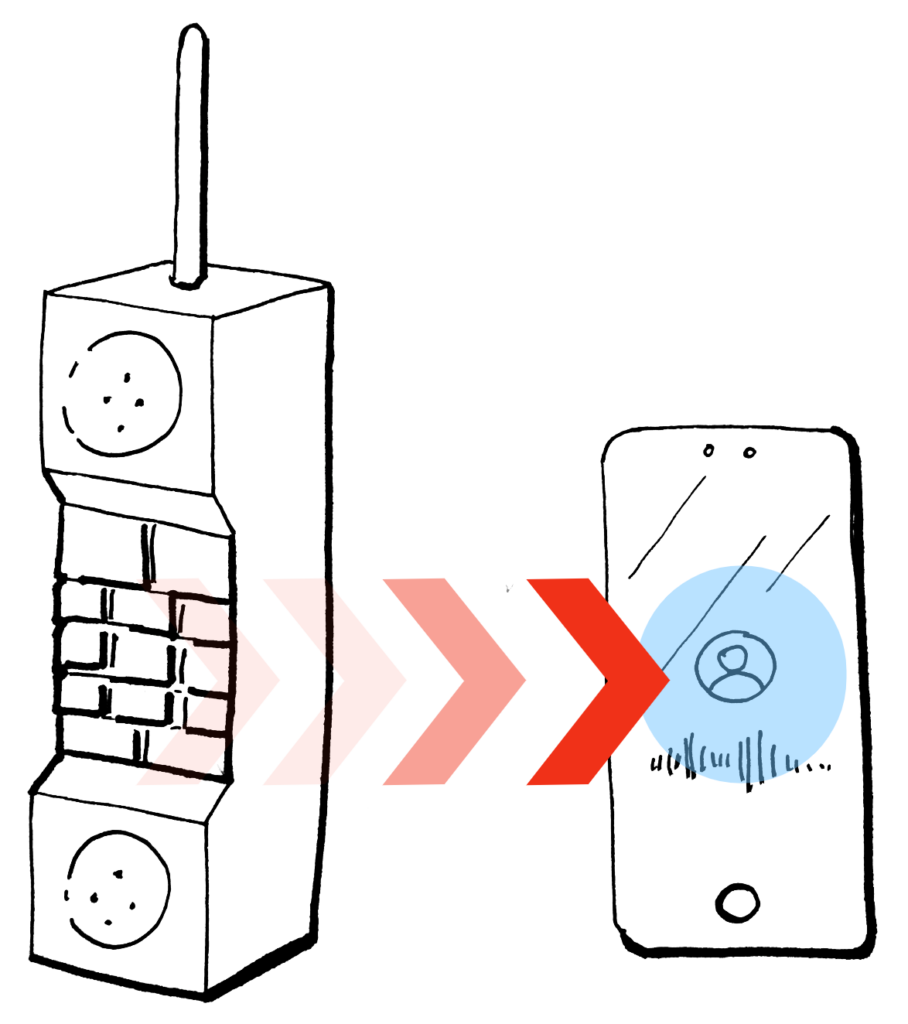
“What we want to do is we want to put an incredibly great computer in a book that you can carry around with you and learn how to use in 20 minutes…and we really want to do it with a radio link in it so you don’t have to hook up to anything and you’re in communication with all of these larger databases and other computers”.
Steve Jobs, Apple co-founder, 1983*.
*This quote is associated with the iPad not the iPhone, but I found it just as applicable, given current smartphone capabilities. See article with link to audio.
“A tiny computer, a phone, a very personal object . . . It must be beautiful. It must offer the kind of personal satisfaction that a fine piece of jewelry brings. It will have a perceived value even when it’s not being used… Once you use it you won’t be able to live without it.”
Marc Porat, General Magic co-founder, 1990.
There is a long, winding path between the visions shared by Steve Jobs and Marc Porat above, and the smartphones that have become ubiquitous today. Steve Jobs, famous for…being Steve Jobs, and Marc Porat, less well known but arguably as brilliant, brought to greater attention by the 2018 documentary “General Magic”, applied visionary inspiration and leadership to push the envelope of personal, mobile computing. Marc Porat and General Magic failed with their Sony-partnered MagicLink device (released in 1994 with little success, the company closed around 2002), while Steve Jobs and Apple released the iPhone in 2007 with overwhelming success that continues on (at least as of this writing).
Originally starting as a spinoff from Apple*, General Magic engineered and patented numerous visionary features, and prophetically saw the importance of key partnerships with manufacturers and service providers across telecommunications. The sketch by Marc Porat depicting an initial smartphone concept is eerily similar to the first iPhone. What eventually became the MagicLink didn’t quite have that sleekness. However, the device seemed to promise the start of the handheld device revolution. It featured the MagicCap OS, a skeuomorphic touchscreen user interface concept essentially mimicking a real office, and many of the productivity “apps” we would recognize today like a spreadsheet, notes, online mail (AOL), calculator, calendar, and of course, the phone (oh and a fax for the Japanese model).
*The documentary General Magic got further into the dynamic between Apple and General Magic, which at times seemed openly adversarial. For example, the Apple Newton coming out in 1992 as a less functional PDA that would compete if not completely undercut the aspirations for General Magic’s visionary device.
General Magic, and it’s brand name partners like Motorola, Sony, and AT&T created an exclusive, closed communication network and operating systems which would service these revolutionary products everyone will want. Perhaps being so focused on vertical integration (and control?) caused them to misjudge the opportunity to bring the internet into their plans, opting for partnerships with traditional carriers. Additional burdens included its $800 price tag, unproven network support, and lack of handwriting recognition, along with other common shortcomings of similar devices at that time, such as expensive data plans, limited battery life and bulkiness. But, the product’s design shortcomings were arguably more a limitation of the times and the cost of covering uncharted territory, as they were a sign of “poor” choices. A lot of time elapsed between 1994 and 2007. All of the technological advances that occurred during that time enabled companies like Apple, its partners, and consumers like us to accept what a smartphone had to offer. In other words, its ease of use, functionality, and value finally aligned on a mass market scale. In those in-between years there were other companies creating myriad versions of devices somewhere between a PDA, traditional mobile phone, and the smartphone we know today. These companies, perhaps with equal commitment to the original vision and inspiration, pushed the technology forward, pushed the features, value proposition, and user interfaces forward through trial and error. Simply looking up “History of Smartphones” in Wikipedia provides a decent summary list of smartphones in this era, which I collapsed into a few groups that are, I suppose, from a user’s perspective:
The hands (1992-1999)
The Apple Newton, The Simon Personal Communicator by BellSouth, Hewlett-Packard OmniGo 700LX, Nokia 9000 Communicator (featuring a clam-shell design with a large screen and a wide format QWERTY keyboard) and Qualcomm released the “pdQ Smartphone”, combined the phone with varying combinations of features that enabled sending and receiving faxes and emails, saving addresses, schedules, presenting stock reports and news updates, and browsing the internet.
The thumbs (2000-2005)
The Ericsson R380, Kyocera 6035, Nokia 9210 Communicator continue and improved upon previous features and internet browsing. The 9210 also allowed for installing other applications. Keyboards optimized for use with the thumbs were featured in Handspring’s Treo, T-Mobile Sidekick, and of course, in the BlackBerry by Research In Motion.
The finger (2006-2007)
LG partnered with luxury brand Prada to introduce the first smartphone with a capacitive touchscreen interface. The design and packaging is amazingly similar to the iPhone, released just one month later in January, 2007. Such similarities make us wonder where the true innovation came from. Nonetheless, Apple’s refined forms, app’s, single button, large 3.5” touchscreen and the ecosystem around it pushed the iPhone to world wide success, setting the standard for smartphones to come.
The rest is history…
For the smartphone, it’s difficult to point to any one person or company, even Steve Jobs and Apple, as THE singular, inspired force above all others. Other innovations might have a hero, or small group as a hero, bringing the world a product that would never occur were it not for their passion. Marc Porat could be credited with at least igniting the spark, but probably not the eventual blaze. To me, the story of the smartphone is one of those more about many people uncovering, like gold during the California gold rush, untapped value that maybe went something like this: we can put more technology in people’s hands to facilitate communication and productivity, we can reduce many devices to one portal, we can sell telecommunications and entertainment services at an individual level, not just a company or household level, and now is the time. Yes, there might have been a couple of key people who could sketch a portrait of what might be possible some day and effectively communicate it to large audiences, but, there were so many that saw it in parallel with them. Collectively, all these players saw an opportunity coming, and took the risk to latch on and figure it out, some more or less ahead of others, some more or less successfully than others.
Why did these companies never give up? What drove them to pursue this idea all those years? Why weren’t the naysayers right?
What does this say about the design process? Could any one company have invented the modern smartphone on their own, without seeing, competing, and innovating on each other’s ideas? From our perspective, as consumers, could we think of all these companies as oddly working together, like one global sized design team? In this case, I could.
Amongst all these players, I will conclude two points of distinction. One, despite its business failures, General Magic* proved to be ahead of its time, let’s say, the first with the modern vision. Two, I think the iPhone claimed the final winning solution. Moving forward, we’ll just have to see what new paradigm opens up, what vein is uncovered that will bring the next gold rush. Advances in Ai and the processing of information and communication will be part of anything that happens, but when and how will the next big physical change take place in communications? Is it robots, is it glasses, is it implants? I don’t know, but it could get messy.
*By the way, Tony Fadell, a key figure in the design of the iPhone, and Andy Rubin, who led the development of the Android OS, both worked at General Magic.
Febreze

“In fact, she owned so many cats that when the researchers walked into her house one of them started gagging when he went into the living room because the scent of cat was so overpowering…And the guy who was gagging says, “what about right now? Would you consider using Febreze right now for the cat scent?” And she kind of smiles and says, “you know, I don’t like to brag, but I have the best cats. They hardly ever smell.” Which is of course when the team realizes what’s going on, which all of you know, which is that if you have bad smells in your life, you become desensitized to them.”
Charles Duhigg, author of “The Power of Habit” (2012), at a presentation, see clip at ~9:00
Procter & Gamble developed Febreze in the mid-1990’s, based on a chemical that they discovered could trap and eliminate scent molecules (via magic, as far as I can tell). The chemical worked so well, it garnered incredible excitement and investment by the company to bring it to market. Here was a case of discovering a solution that didn’t require finding a need, that seemed obvious. Rather, it was a solution in search of a marketing campaign.
*To read and see more, Peter Cohan’s Forbes article covers the basic story here, while Charles Duhigg’s presentation on habits is worth watching in its entirety.
Having a smelly kitchen, chair, clothes, car, pet, or anything else, was something everyone could relate to; a mass market need. The technical, business, and marketing stakeholders were all behind the initial releases. There was only one small issue; users didn’t seem to know what to do with it. They certainly were not having the “experience” the team so carefully crafted for their enjoyment.
The Febreze marketing was based on the habit loop; cue – there is a bad smell, routine – I clean, reward – no more smell. Isn’t that great, it’s so simple! Unfortunately, lackluster market performance was demonstrating that this obvious behavior pattern might be anything but. P&G even considered killing the product line due to poor sales. It would have been reasonable to do so. As the adage goes, don’t throw good money after bad. They were face to face with the sunk-cost fallacy, which is our desire to continue pursuing an outcome, or project, because we have invested so much effort into it already even if the chances of failure are becoming more apparent.
However, P&G did not stop. They went back to the drawing board. Actually, they went back to their user research videos. They learned two critical lessons: people cannot feel rewarded for eliminating an odor they cannot smell, and cleaning itself was a reward (regardless of funkiness, I suppose). In regards to the first lesson, they visited a customer who’s house was full of cats and smelled, to presumably all but her, quite bad. She didn’t find much use for Febreze because her house didn’t smell bad to her, she was desensitized to the odors. In regards to the second lesson, they watched another woman stand back after cleaning, to appreciate her work, and sprayed a mist of Febreze. She explained that there was something nice about completing a task and spritzing the Febreze, almost as a reward or signal, of her accomplishment. In both cases, P&G missed these incredible characteristics. We can’t all relate to habitually bad smells in our home (enough so to use bottles of Febreze at a pace to support their sales goals anyway) because we become habituated to them. However, we can all relate to the sense of satisfaction we have after cleaning a room, our clothes, a carpet, etc. P&G changed their marketing, latching onto that existing habit, and adding another sensory experience to the reward of satisfaction and cleanliness. The act of spraying the pleasant scent was no longer tied to the cue of smelling something bad, rather it was in conjunction with something pleasant, making their home even more pleasant. The new ads hit their mark, depicting the joys of cleaning and tidy homes, and celebrating with an added bit of breezy, fresh scents. Febreze sales took off, and eventually grew to a billion dollar a year business- a smash hit for P&G.
During their missteps and roller coaster ride to success, P&G must have considered their risk carefully. Were they falling victim to the sunk-cost fallacy and couldn’t see it, just like the cat-lady couldn’t smell how bad her house was? There is never a guarantee, and there is no playbook that fits every scenario. Febreze could have failed, but team members were inspired enough, by what exactly is difficult to say, to dig back through their work, to leave no stone unturned. Perhaps the cost of producing the liquid was so low that they felt they had a fair amount of room to experiment with the marketing to get it right. Perhaps the liquid’s almost magical ability to eliminate odors was simply too profound, too fundamental, to let a little thing like user research get in its way ; ). They didn’t exactly need more research, they needed a new perspective on their research. The right scheme was there all along. Maybe they needed a bit of a scare to finally see it.
Post-it Notes
“It was part of my job as a researcher to develop new adhesives, and at that time we wanted to develop bigger, stronger, tougher adhesives. This was none of those.”
Dr. Spencer Silver, scientist who discovered 3M’s Post-It adhesive
3M develops a wide range of adhesive and products featuring adhesive, such as the original Duck tape brand. They also developed that ubiquitous office supply; the Post-it note. It might be hard to imagine (unless you have heard this story before) that the invention of the Post-it was not only an accident, it was a complete failure – at least in terms of making stronger adhesives.
*3M actually spells out this entire story on a dedicated page, so to hear from them directly, go here.
One of the 3M scientists, Dr. Spencer Silver, ostensibly tasked with the mission of making stronger and stronger adhesive formulations, created a formulation that did not adhere well to surfaces. This formulation of “microspheres” that he invented seemed novel, but it could easily fall off, get bumped off or peel off with very little effort. In other words, it enabled stickiness without permanent or aggressive bonding. Dr. Silver was convinced that this formulation held value, but like his invention, the idea didn’t seem to stick well with others. Fortunately for all of us, he stuck with it and adhered to his belief in the product. (Here ends the puns).
It wasn’t until another colleague, Art Fry, had a eureka moment that touched off the launch of a product that could capitalize on this weak tape. Art wanted a tab or bookmark that could be placed on his church choir hymnal book that would stick for some time but not cause damage to the paper. He recalled a company seminar about Dr. Silver’s not-so-great-but-sort-of-adhering microspheres, and realized there was a use here. As they started working together on this “bookmark” product they still didn’t see the full picture. They stumbled upon the eventual use of the product simply by passing notes to each other in the office. In other words, they found out that temporary messaging, as opposed to writing for the purpose of historical record, was actually a valuable use case. Imagine the spirit of SnapChat or X/Twitter, but in a physical form. What would you get?
The duo prototyped the product internally and the idea gained traction and excitement. Pilot releases quickly proved that consumers also found value in the ability to send temporary messages and notes to each other. According to Silver and 3M, “…like many ground-breaking innovations, theirs was a product nobody thought they needed until they did.” Even that standard yellow color was randomly chosen because that was the color of paper available when they were playing with the idea in the lab.
By the mid 1980’s the Post-it product line was a huge success for all sorts of office applications. Since that time, myriad variations in sizes, colors, and packages have found applications in more than 1,000 products across 150 countries. The Post-it, it seems, became truly worthy of McLuhan’s assertion that “the medium is the message”, and then even went on to transcend it, as Post-it notes became an app you could use in your digital desktop as well; useful regardless of the medium.
Hitting close to home, as they say, the Post-it became an iconic symbol of “design thinking” with techniques like storyboarding and card sorting due to their ability to promote simple communication (e.g., due to their size limiting the amount you could write on them, hence encouraging conciseness and speed – not unlike Twitter) and fluid thinking because you could move them around easily. Similarly, these use cases also transcended from paper to digital in white boarding apps like Miro, giving globally dispersed teams the ability to work together pulling note cards and posting ideas! It is either ironic or fitting (which do you think?) that one of the most iconic objects that we associate with the hallowed process of “design thinking” came to being by accident and fortuitous meetings. Either way, they developed something useful, and provided us with the ultimate example of, “when life gives you lemons, make lemonade”.
The Traveling Clog Family
Perhaps we take for granted the moments of epiphany that happen in our lives. They are not always life changing, nor always seem to have intrinsic value. However, like the previous examples, we experience idiosyncratic processes and moments of inspiration in our work too. I thought it fitting to share an example of my own.
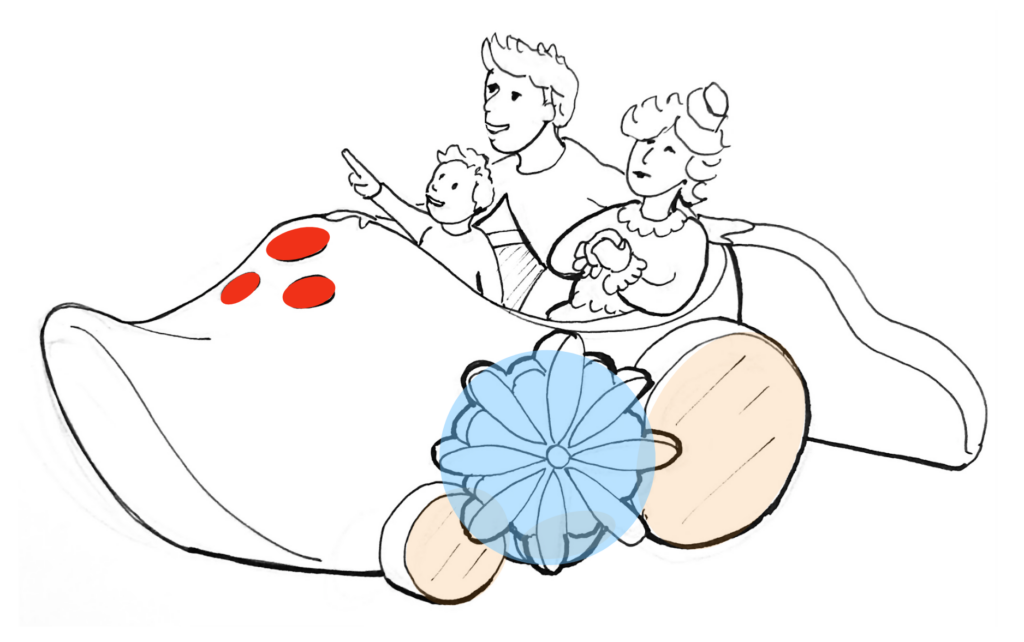
Amongst all the projects, with their share of twists and turns, that I have participated in over my career thus far, one of my favorite examples of epiphany is the Traveling Clog Family. For one of my junior year projects as an undergraduate we were asked to create a wooden toy with three mechanical actions. The goal was to learn how to craft with and embrace the unique qualities of wood. I sketched ideas, wrote down qualities and characteristics I wanted to highlight. The ideas were reasonable solutions for meeting the design brief. Some were more or less interesting to me. Then, one day, with no prior thinking along these lines, I sketched something like the image at the start of this story (I couldn’t find the original sketch, but basically it was a clog with gouda cheese wheels).
Not only that, an accompanying story spilled out almost immediately as well; a Dutch family ate some Gouda cheese with a magic spell that shrunk them, and now have adventures traveling around in a wooden clog. This idea fit so many of the project goals: the clog is an interesting wooden shape requiring careful crafting, the people could be turned on a lathe, I could include bright colors but also wood grain, I could easily find three mechanic actions in what is essentially a vehicle toy, and the overall aesthetic of wood fit the old fashioned story and theme of wooden shoes and 19th century Holland. In those brief moments, the entire project sprung forth from my head, nearly complete. The execution was merely a formality. That is not to say the refinement and building was easy, but the end design, for which I wrote a complete story line and colorful illustrations, presented very well and got me an “A”.
Design projects in the junior and senior years of an undergraduate program typically require a large investment of time and commitment. Similar in some ways to the real world, we have to find a path, build confidence that is going to work, then execute against the clock. It is fascinating to look back on what we commit ourselves to and why. At some point we have to make that leap and go all in on an idea to see it through because only in the finished result can the idea be truly judged. Sometimes, what might seem like a half-baked idea on paper can, upon its fully executed form, yield a fantastic end product. How did I decide my little sketch was worth dozens of hours in the design studio? Why was the idea so complete from so many different angles, so quickly? What made me leap so fully into it with little thought of alternatives after that? Part of the answer, of course, is the freedom and safety of the academic environment – that should be the case while you’re in school. But, it’s not so clear why it “clicked”, it just seemed like the right way to go, and I am glad that I saw it through.
If reading in order, the next chapter is, What do these stories tell us?