

What do these stories tell us?
There is an interesting prologue to the Traveling Clog Family story (one of the stories in the Four stories chapter). Many years later, at a family get-together my college project came up while talking to my wife’s aunt and uncle. Her uncle was from Holland and her aunt and uncle had lived there together for some time. I showed them the toy, which I still have, and told them the story about the shrunken family that would travel in it. My wife’s aunt almost immediately said, ‘that’s great! like the story of Wynken, Blynken, and Nod.”
The story of Wynken, Blynken, and Nod is a poem (essentially a bed time story) by Eugene Field in the late 1800’s about three children who went fishing at night “amongst the stars” traveling in a wooden shoe. (Clip of 1938 cartoon).
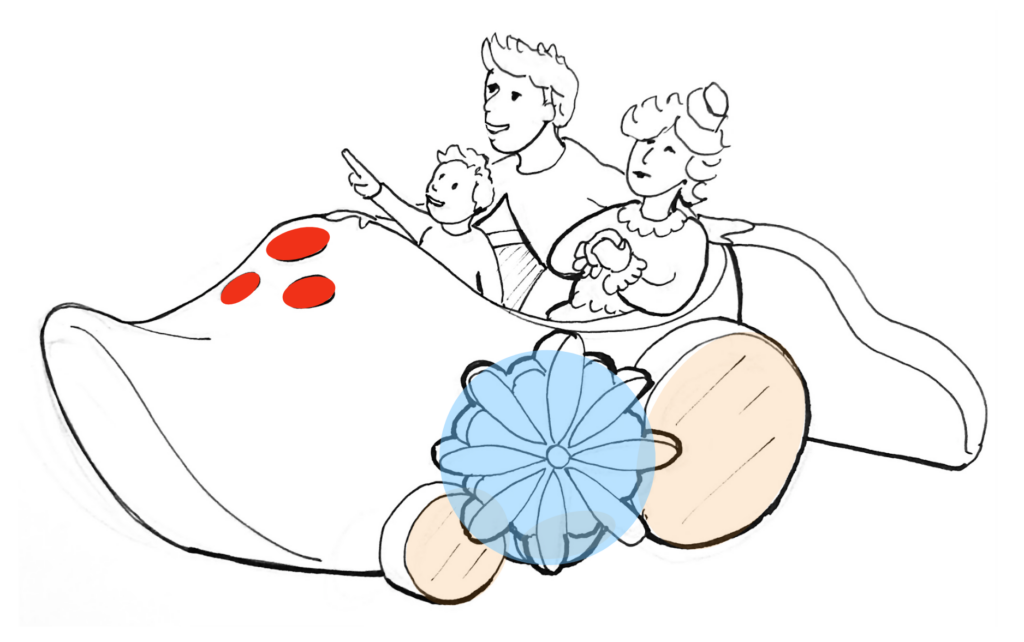
Sketch of my Traveling Clog Family toy
I was taken aback when I saw the images from the various books that have been published over the years. I could not remember ever hearing this story as a child or coming across it at any point in my life. I wouldn’t have thought twice about referencing it directly for my school project. Had I seen it then, it certainly would have saved me some time. Perhaps my mom read me this bed time story, or I came across an old book and the imagery stuck with me. I actually would like to believe that somewhere deep in my mind there is a memory of this story. What else could explain such a strange epiphany for a toy concept? But then again, what gave Eugene Field the idea for his poem in the first place?
Perhaps our inspiration, our ideas, and the strength of our belief in them is not coming from nowhere, as it sometimes seems. Perhaps they are products of active and subconscious information processing – our brain taking in information, sorting it, filing it, but not necessarily connecting it…yet. I imagine our neurons firing in a complex “structure” of disconnected nodes lighting up at various times and combinations, yet missing that one neuron puzzle piece that could connect them all…until that moment when the right input (or uncovered memory?) finally triggers it, creating one interconnected structure, even if for a moment, out of thoughts and memories.
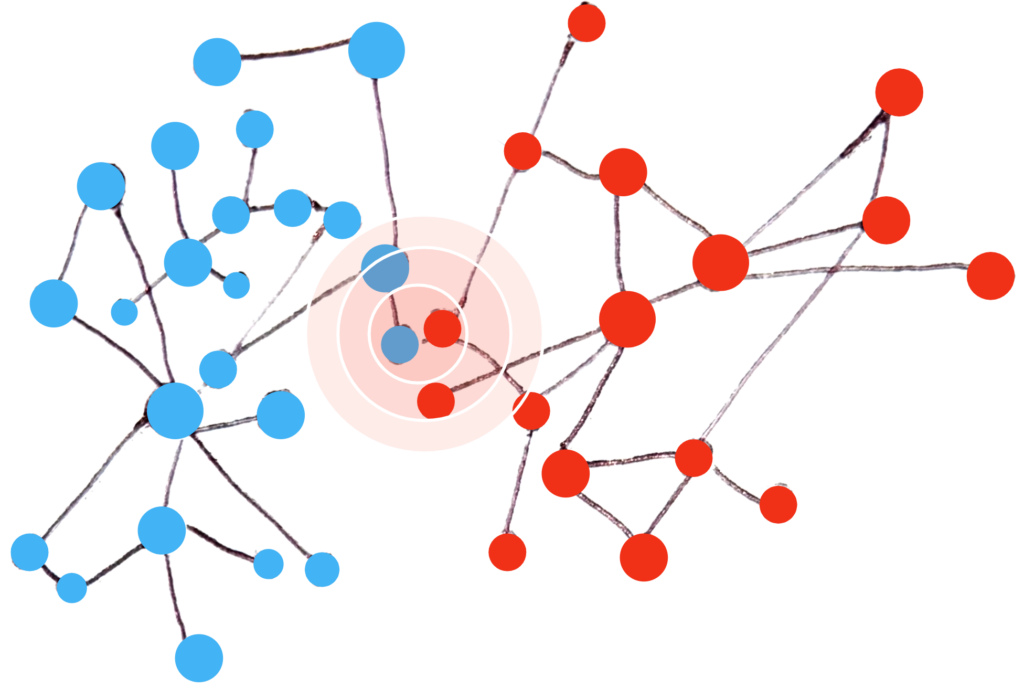
How I imagine the “Aha!” moment coming together in the mind.
I’m not sure my mental image of this process is consistent with research on insight and problem solving, but at minimum it feels like an appropriate metaphor for my experience of creative insight. I went back to find some references related specifically to whether and what processes of the brain were responsible for experiencing an insight. Quickly, however, I had the distinct feeling of falling down the rabbit hole. But, I did feel my intuition was relatively aligned (or perhaps that’s just my cognitive bias, another rabbit hole) with what I was reading. Recognizing my attempt to summarize this research cannot do it justice, I’ll at least share my key take away, which I hope is relatively accurate:*
Areas in the left hemisphere (LH) of our brain conduct narrower, detailed semantic coding related to the inputs, thus this has a stronger focusing effect on our attention. By contrast, our right hemisphere (RH) conducts broader semantic coding that can have larger overlapping areas into information that might be unrelated – this makes it slower/weaker or less attention grabbing, so in some cases might be occurring subconsciously (though neither hemisphere is exclusively conscious or subconscious). Eventually, there is a process in which the brain either makes the connection between the problem at hand and whatever relevant piece(s) in the wider memory of experience, or allows those pieces to transition from subconscious to conscious thought, which produce an “insightful solution”. This moment at which we become aware of the solution is then subjectively experienced as the “Aha!” or “Eureka” moment.
*This was mainly based on the conclusions of these two papers: Neural Activity When People Solve Verbal Problems with Insight. and Aha! Insight experience correlates with solution activation in the right hemisphere. However, I found these other sources helpful, and seemingly consistent/supportive of the same ideas: The scientific study of inspiration in the creative process: challenges and opportunities, Making Connections: Psychologist explores the neuroscience of creativity, What’s Up With That: Your Best Thinking Seems to Happen in the Shower.
Like many topics that are relevant to the design process, the science behind how our brain works during problem solving is a fascinating one, and would likely yield more useful insights into design. For example, as described in the What’s Up With That: Your Best Thinking Seems to Happen in the Shower article, taking a mental break to ease up the constricting effect of mental focus can re engage the more free-range thinking that could help solve the problem you are focusing on in the first place. Or, get in the habit of providing an easy way to record ideas where you know you will be disengaged (e.g., a “Poop Journal” in the bathroom). However, I will reconnect with our current topic in this way: the relationship we might have between active attention, processing and learning (consciously or subconsciously), and seemingly spontaneous ideas, seems to parallel the relationship between user research and design in product development. Perhaps we are always conducting “user research” when we experience life and learn new facts. When we feel we have had enough, or the opportunity arises, our brain shifts into design-concepting phase and emits an idea that addresses problems or opportunities we processed from our experiences. This is not to equate the value of any one person’s subconscious with the time and effort set forth conducting robust and well-planned user research. In fact we should employ a healthy skepticism of our initial reactions and try to determine the validity of any insight compelling us forward. However, we should never be dismissive, because there is never just nothing behind it.
It can take you time to process the value of what you experience. This is true of life, on a grand scale, and life’s little moments, but it’s also true when developing conclusions from research we conduct during product development. An often heard phrase when reading or writing a research report is “so what?”. Meaning the data itself ( how many people preferred this vs that, how people did this correctly or incorrectly) doesn’t tell you why something happened, what it’s value is to the overall experience people could be having, and importantly what you should do about it! That takes analysis, insight, processing, and maybe just a bit of “Aha!”.
Our insights, whenever they occur, still need to be vetted and proven in numerous iterations. Iterations of analysis, design, testing, marketing strategies, sales strategies, production and tooling approaches, management review, etc. No single iteration is expected to be perfect or all encompassing. Nor would you expect each iteration to follow the same combination of circumstances, efforts, insights, and collaborations.
However, to succeed and “hit a home run” that tumbling cycle of development for any product must ultimately cover all the same ground and bases. The variable – the part that might actually not matter as much as we think – is the relative timing of all those inputs. If we were to carry the metaphor, imagine playing baseball where it doesn’t matter which order you touch the bases, just so long as each player touches them all you get a run. That would be quite a different game…ok, metaphors have their limits. Put more simply, if we assume too prescriptive of a sequence we impose upon ourselves a penalty for recognizing insight and innovation where and when it occurs naturally. Convenience and smoothness imply that plans and decisions unfold as expected. Anything unplanned is by definition inconvenient. Unfortunately the natural state of insight seems to be inconvenient. Given how often “insights” occur, and the impact they often have, we can conclude that they can be valuable, but we must accept that we will not exactly control when they will happen.
Thomas Edison said that innovation is 1% inspiration and 99% perspiration.* Even if we do not assume such a lopsided ratio, it’s probably pretty high. But, I do not believe that a focus on perspiration means ideas and inspiration are not valuable. Rather, it just means the value has to be proven. Perhaps it’s not so important where or when an idea occurs, only that we commit ourselves to the perspiration of running any promising idea through the gauntlet of analysis and testing required to prove its value…or back through that gauntlet, if that is “inconveniently” the case. This is true of insights that are additive (e.g., wouldn’t it be great if the product did this) and reductive (e.g., this isn’t worth it, let’s take it out).
*Its worth noting that there are various ways to carve up “insight”, “inspiration”, “perspiration”, “execution” etc. I am using these terms in a somewhat overlapping manner that I think is ok for these purposes. Like many quotes, there is also plenty of variation in Edison’s famous saying, but I think the overarching point can be understood.
Experienced user centered designers would likely agree that a good design process includes those opportunities for magic to occur. Techniques like participatory design, design thinking exercises with non-designer stakeholders, and other activities are based on the idea of expecting the unexpected. There is nothing in the various formulations of the UCD process diagram that precludes insight and inspiration. It clearly points to the iterative nature of the creative process. The more companies can apply these techniques and processes the more tools they have to succeed. The popularity and recognition of design thinking and user-centered design has been a tide that raises all boats.
Perhaps the MILLION DOLLAR (or is it billion, or trillion?) question is, how can we know if development will succeed?
Looking at the stories shared in “Four stories”, one could conclude, quite logically, that such stories are examples of a few products that happen to succeed despite a rather chaotic development process – it would stagger the mind if we were to try to count those development efforts that failed due to poor adherence to the user centered design process. However, the issue seems less black and white than assuming the degree to which you follow a process equates to the degree to which you succeed. If that were the case, then those four stories succeeded because they were lucky. Conversely, this would mean that products that failed even though they followed the steps of a solid process were simply unlucky. Either of those conclusions seem overly simplistic. The concept of luck, or uncontrollable circumstance, is always a factor. However, if it is a factor on both sides of the equation, success and failure, then I am content to cancel it out as a determining factor, and simply accept that there will be myriad variables we deal with along the way. Similarly, inspiration and insight, from ourselves or anyone else involved in the product development process, are uncontrollable variables present in successful and unsuccessful efforts. The question of whether or not we succeed will also depend on how we deal with each other’s insights and inspiration, how and when we work together, how well we do our jobs and understand the jobs of others. These are things that vary from team to team, time to time, project to project. Success in any development effort will then presumably always hinge quite heavily on the combination of, and uniqueness of, the people involved.
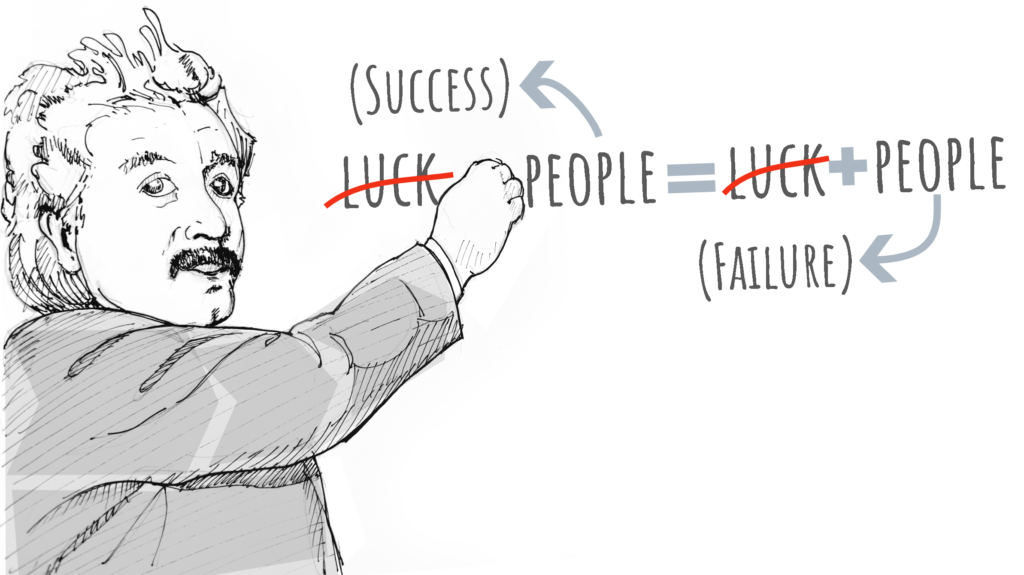
Thinking of process in this way doesn’t change what we do. It doesn’t void the appropriateness of the process we have come to know and leverage. But, looking at it in a different way might give us permission to think differently about what we are experiencing; what is really going on with us. We are the tools of development just as much, if not more, than any software, hardware, electronics etc. Painting a different portrait of the process (whether yours looks like what I drew or is different) might simply help us get out of our own heads and give us permission for the flexibility we know we’ll need. So that if we need to redo, repeat, rethink, we understand that we can. It might help us consider how and why inspiration, insight, and (dare I use the “s” word) synergy amongst teammates occur, and where that comes from, rather than feeling like all we can do is throw up our hands and tell ourselves there is nothing else we can do but take the next steps and check the next boxes.